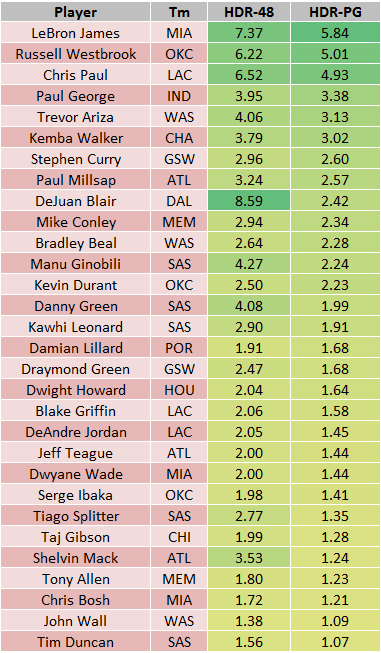
I've rolled out the Blend Score ratings for the top 30 NBA players in the 2011-2012 season.  To qualify for the list, a player needs to have averaged at least 20 minutes per game, and played 1,000 total minutes.  
Remember, if you need a refresher on what the "Blend Score" entails, simply click on said tab to your left. 

I logged these numbers for every NBA player, totaled them for each team, and regressed them on each teams actual winning percentage for the 2012 season. There was a 90% correlation (R squared) between Blend Player Ratings, and winning games during the 2012 campaign.  This is a bit low, but 2012 WAS a lockout year, AND I'm now using new Wins Produced numbers instead of old Win Score values.  

This was primarily due to convenience, as I couldn't get the appropriate data for large scale position adjusted win score calculations.  I feel okay doing so however, as there is reportedly a 97% correlation between old and new Wins Produced numbers, via Wages of Wins.  

I'm going to do the numbers for a few more seasons, and see what the correlation looks like over long periods of time.  I might also roll out the predictive Blend Player Ratings (as opposed to the explanatory one I'm doing now), test its predictive ability, and mesh it with the current system, to give a "wholesome" player rating.  
 
 
I was messing around this past weekend, and decided to take a hard look at rebounding.  No, this isn't a debate on its value or what it means, simply some fun with Basketball Reference. 

The idea was to rank NBA players' rebounding ability based on not just production, but height and position.  Many studies have shown that rebounding rates increase with height, although that's fairly noisy, as increased height usually leads to closer proximity to the basket, where rebounds are plentiful.  Anyway, to be "fair", I decided to compare rebounding rates between players who share the same height/position, in order to determine "actual" rebounding prowess.  Think of this as a "position" adjustment, with the position also including height. 

I wanted the pool to be as error-proof as possible, so I only selected players from 1979-2013, who played at least 200 games, and averaged at least 20 minutes per game.  The reason for this should be fairly obvious, as rebounding rates for "low-usage" players can fluctuate wildly due to their small amount of playing time.   

To rank these players, I standardized the Offensive and Defensive Rebounding Percentages (OREB and DREB), multiplied the OREB value by 2, and added it to the DREB value.  While many analysts may disagree about the actual value of a rebound, most concede that an Offensive Rebound is worth double a Defensive Rebound, so I decided to adjust for that as well.

Why does any of this matter?  For one thing, its entertaining.  I think its fascinating to see where the All-Time Greats rank when approaching rebounding through this method. Also, I think the concept is important.  Traditional position adjustments while helpful, are woefully outdated.  The minds at Wages of Wins have been working on this issue for a while, and I think a quick construct that included height could be at best telling, and at worst, entertaining. 


I've finished the ratings for the guards, and will be working on the wings and big-men.  Your patience and time are always appreciated.

*Weebly is being stupid right now, so I could only post the Top 45 Guards, in terms of Adjusted Rebounding Score.  Will fix as soon as possible.  
 
 
Many of you may have read a piece over at Sports Skeptic a year ago, which compared a smattering of NBA player evaluation metrics.  What I found interesting was the concept of "blending" various metrics together, to either explain or predict an NBA season more accurately then any one metric could do on its own.  I decided to use the idea put forward by Alex Konkel to determine the All-NBA Teams for 2013. 


Alex came up with two "blends" of metrics during his study, the explanatory blend (described what happened) and the predictive blend (predicts what will happen next season).  Obviously we'll be using the explanatory blend, to determine who the best players were in 2013.  The rough formula for the blend is as follows:

[.5 x old Wins Produced (per 48) + .35 x Advanced Statistical Plus Minus + .15 x Win Shares (per 48)]

I didn't have access to the old Wins Produced numbers, so I just used position adjusted Win Score.  Professor Berri says there is a .994 correlation between the two, so I felt pretty safe with this cop-out.  Anyway, here are my All NBA Teams for 2013, based on the explanatory blend.  
First Team
Chris Paul
Dwyane Wade
Kevin Durant
LeBron James
Anderson Verajao 

Second Team
Russell Westbrook
James Harden
Kawhi Leonard
Tim Duncan
Andre Drummond

Third Team
Tony Parker
Kobe Bryant
Shawn Marion
Reggie Evans
Tyson Chandler
These weren't the top 15 players based on "The Blend", but I had to shift a few names around to make actual teams.  Thanks to the Sports Skeptic, Basketball Reference, and GodismyjudgeOK, for providing the stats.  

If anybody's interested (I know you are), I'm posting the "Blend" numbers for the top 30 players in 2013 on a side tab.  To qualify for the list, you had to have played at least 20 minutes per game, and played 4 games (I know, very arbitrary). 
 
 
I feel like this post needs to be written, as their is currently a huge debate over who the best Shooting Guard in the NBA is.  Every reasonable fan acknowledges Chris Paul is the best PG, LeBron is the best SF, Love (when healthy) is the best PF, and Dwight (when healthy) is the best Center.  However, the topic of Shooting Guard is much more contentious, and so I've decided to settle it for the 2012-2013 season. 


There are really only 3 legitimate candidates for the title of best off-guard in the world.  Kobe Bryant, James Harden, and Dwyane Wade.  These 3 are clearly fan favorites, and are also roughly top 5 at their position, as far as advanced stats are concerned.  Their will be two categories used to rank these 3 players.  An objective approach (Stats) and a Subjective approach (the other stuff). 


To determine which Shooting Guard is statistically the best, required a variation of the Win Score formula (Wages of Wins), and an added defensive component.  This defensive component includes Defensive Rating and Synergy numbers.  Since defense is such a gray area in the NBA, I made sure this defensive adjustment wouldn't overtly sway the results of the initial "Win Score" calculation.  


"Win Score"=[Points + Offensive Rebounds + Defensive Rebounds *.5 + Steals + Blocks*.5 + Assists*.5 - Field Goal Attempts - Turnovers - Fouls*.5 - Free Throw Attempts *.44]


Remember, this is a simplified version of Dave Berri's "Wins Produced", a possession based player evaluating metric that can explain roughly 98% of all wins. 


The numbers used for each players stats were Per 100 possessions, which were slightly different (and better) then their Per 48 minutes stats.  The number below is the "Win Score" WITH the Defensive Adjustment.  

              Player               Score
        Dwyane Wade =   12.8
        James Harden =    9.63
        Kobe Bryant  
 =    7.39


Prior to the defensive adjustment, Wade and Harden were very close.  However, while James Harden got only a slight boost from his defensive acumen, Wade got a fairly large one.  Kobe Bryant wasn't too far off in the beginning, but he registered a negative Defensive Adjustment, which created considerable separation.  


Now for the Subjective stuff.  While Dwyane Wade did indeed score the highest, he's also played the least amount of games and minutes. On the flip side, he's clearly missed a few games he didn't have to for, "rest and recovery" prior to the Playoffs.  Both Kobe and Harden have played high minutes, but there really isn't enough separation from Wade to give them a significant edge. 


There's also the LeBron James factor.  Wade happens to play with the best player in the world, and while I haven't finished my analysis for the Heat yet, its clear Wade benefits from LeBron's presence.  As illustrated by an earlier article I wrote however, its clear Kobe Bryant has benefited more from Dwight Howard's presence, then Wade has from Lebrons'.  Harden is pretty much alone as far as super-star teammates are concerned.


The last topic discussed is "teammate-ness".  Harden is pretty neutral on this front, as nothing really good or bad has come out about his persona.  Kobe on the other hand, fails.  Even Bryant himself acknowledges he can be a tough teammate to play with, and not ceding the team to Dwight is one of the reasons the Lakers are in dire straights.  Wade on the other hand, has a solid advantage here.  Putting team success ahead of personal glory makes Dwyane a teammate anyone would want to play with. 


This leaves Harden as the winner of the "subjective" group.  He's the only player of the 3 to consistently be the number one option or his team, and "carry" them to victory.  While his Rockets clearly have some talent, Harden has gone above and beyond expectations by carrying them to a 6-seed in the West, and has a real possibility of leading an upset against a higher seeded favorite.  He's played a lot of minutes, and seems like a good teammate. 


In conclusion, this is still pretty hard.  Dwyane Wade and James Harden are clearly the two best Shooting Guards in the world.  Pound for pound, possession for possession, Wade is more effective.  He's dynamic on both sides of the court, and a great teammate who puts the team above his own personal success.  Harden on the other hand, means much more to his team then Wade, and has single-handedly (kind-of) carried them into the Playoffs.  In my opinion, this is a toss-up.  You can't go wrong with either guy, and your decision will likely come down to who you like more, then who the better player is. 


In honor of the soon to begin NBA Playoffs, I've put together a list of the greatest NBA Playoff scorers of all time (or at least since the 3-point era).  Shout out to Andres Alvarez at WOW for the idea of "Net Points", which will be the primary tool used to rank each player.  I've tweaked it a little bit to reflect the HDR concept, but the general idea is exactly the same. 


Net Points = (Total Points - FGA*.93) - FTA*.98 *.44


Net points is a much better gauge of scoring ability then PPG (Points per Game), but easier to understand and apply then TS% (True Shooting Percentage).  The idea is, that points are good.  However, every time you take a shot, miss or make, you lose your team a possession (-1).  If you are both a volume scorer, as well as an efficient scorer, your Net Points will be high regardless.  However, if you are one without the other, you won't fare so well.  


As you can see, I didn't use -1 as the value of a field goal or free throw attempt.  This reflects the ideology behind my HDR, which is that based on offensive rebounding percentages across the league, a used shot isn't worth -1, but -.93 (-.98 for FTA).  Not a huge difference, but notable.  


To qualify for the ranking, you had to be in the top 100 of playoff point totals (all time).  From there I just ran each player through the Net Points Formula, courtesy of Wages of Wins, to uncover the greatest Playoff scorers of all time.  I'm posting the data on the side tab under "Net Points".  


I have recently stumbled upon a website that makes looking at on/off stats fun.  NBAWOWY is the name for those who aren't familiar, and if you haven't checked it out already, drop what you are doing and get to the computer.  


I decided to look at the Los Angeles Lakers, and in particular, Kobe Bryant.  While not on the LeBron/Durant level many believe him to be, Kobe is still having a great season, and I wanted to see why.  Most believe its a combination of the Nash/Dwight/Gasol tandem taking pressure off Kobe, but when examining the off/on numbers, it seems this thought is only half right. 


To see which of the 3 "all-star" caliber players on LA is impacting Kobe the most, I looked at 3 major categories.  Scoring ability (True Shooting Percentage), play-making (assist to turnover ratio), and rebounding (total rebounding rate).  

For each category I tested 5 different lineup combinations with Kobe.  There is the "scrub" lineup, where Kobe is not playing with Gasol, Dwight, or Nash, and is therefore playing with the, "Scrubs".  There is the "all-star" lineup, where Kobe is playing with all 3 of the above players.  Then there are 3 combinations, where Kobe take turns playing with two of the "all-stars" at once, but not the third.  

I measure how Kobe's effected by these lineups with a simple subtraction.  Example.  If Kobe's average TS% for the year is 57%, and he is shooting 52% with a certain lineup, I simply subtract 57% from 52%, to get the difference, which accurately depicts how much Kobe is being effected.  


All stats are playing time and pace adjusted.  

Kobe's Scoring Ability (TS%)

Kobe's Play-making Ability (AST/TOV)

Kobe's Rebounding Ability (TREB)

Okay a few things to look at here.  First, Kobe's scoring ability has been completely tied to Dwight Howard's presence on the floor this year. Even with Nash and Gasol on the floor, when Dwight is missing, Kobe is shooting a full 10% under his season average.   The rest of the scoring chart is logical.  When Kobe is forced to carry the scrubs without help, he shoots 4% lower, but with Dwight, Gasol, and Nash with him, he shoots 6% higher. 


The Play-making chart is intriguing, as it follows an opposite pattern. Kobe is a more effective play-maker, when either Gasol or Dwight is out, but Nash is still on-court.  He's still above average when all 3 "all-stars" are with him, but quickly falls under average when Nash exits the game.  Predictably, Kobe is at his worst when Gasol/Dwight/Nash are all out, and Kobe has to carry the "scrubs".


The Rebounding chart was also pretty interesting, as it challenged conventional wisdom.  Many make the argument that Kobe has deflated rebounding numbers because he plays with two 7-footers, in Gasol and Dwight.  However, its clear that the presence of these behemoths are actually helping Kobe gather rebounds, probably due to them boxing out and occupying bodies that would otherwise be rebounding.  Indeed, the only time Kobe rebounds under his season average, is when the "Big-3" are off the court, and its Kobe carrying the scrubs. 


Now for a few quick closing comments.  Although Dwight has been only a shell of his former self with the Lakers, he has tremendously improved Kobe's scoring prowess.  Its also clear that Kobe's play-making and rebounding abilities aren't overtly influenced by his teammates, although they clearly digress when Kobe's isn't surrounded by talent.  


That's all for now.  I might do one of these for Dwyane Wade and the Miami Heat (LeBron/Bosh), with Westbrook/OKC being a possibility as well.  Remember, these are on/off numbers for a single season, so we should take them with a grain, or jar, of salt.  Nonetheless, its still fun to play with, and the results can be intriguing.  
 
 
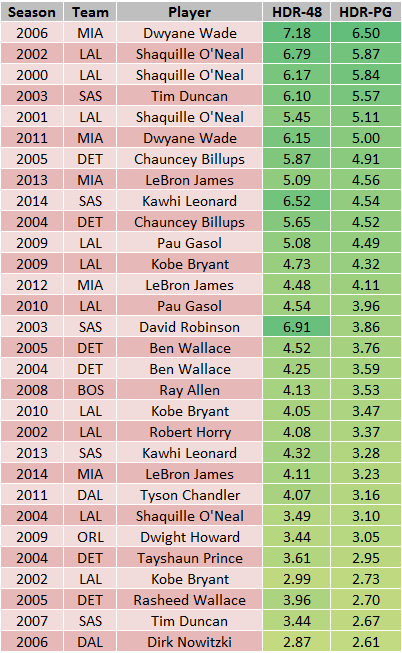
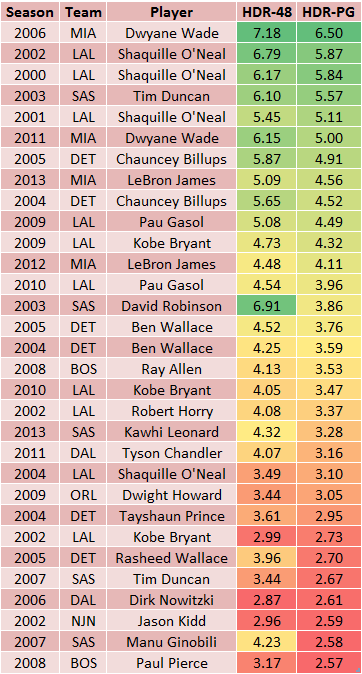
Hey everybody.  My free time has recently been decreased exponentially, and so has my article output.  I have big things planned for the playoffs, but until then here is an "update", on HDR, as I applied it to every NBA Finals match-up since 2001.  I stopped there, because we then start to run into serious pace issues, which would significantly skew the results.  

On another note, it seems my HDR is beginning to look more and more like the Win Score formula. As an example, missed shots started out as -.75.  After some experimenting, its now moved up to -.95.  Likewise, assists have come down from +1, to +.7.  There is still plenty of work to be done though, especially in light of some Sports VU data I have seen.  

Top NBA Finals by Year

In the last 12 years, it would seem the Finals MVP has been awarded to the wrong player 5 times (shocker).


In 2005 Duncan won the MVP, but according to HDR, it should have gone to Ben Wallace.  Tim Duncan only scored 2.15 points lower in HDR though, and since his team did win, so it wasn't to bad a slight.

In 2008-2010, Pau Gasol was robbed of the MVP, once by Pierce, and twice by his teammate Kobe Bryant.  2008 is excusable, as Gasol only scored 1.06 points higher then Pierce, and his team lost. 
2009-2010 aren't excusable.  Gasol was on the winning team, and had an HDR 4 points above Bryant's during those two years.  

The 2011 NBA Finals was highway robbery.  Not only did Dwyane Wade put up the best Finals Performance since 2003, but the MVP actually went to Dirk Nowtizki, who scored a full 8.12 points lower then Wade!!!  Clearly, being on the winning team is a must when attempting to garner such a prestigious award.
 

Top 10 NBA Finals Performances - Single Season

These  are the 10 best NBA Finals performances since 2001.  Most of these names aren't surprising  although it was interesting to see Billups and Kidd rank so high.  To qualify for this list, you had to have played at least 30 mpg, so I have to give a shout-out to David Robinson and Robert Horry. Both players would have made this list, but they only played around 25 mpg.    

Top 10 NBA Finals Performers Overall 

These are the 10 best Finals performers on average, since 2001 (minimum 2 Finals played). Robert Horry, Mutombo, Rondo, and Ben Wallace were all pleasant surprises. I know WP loves Ben Wallace, and its clear he wasn't just a Regular-Season performer.  Rondo impressed, as his 2 Finals appearances occurred before he hit his prime. 

That's all for now.  Whenever I get a chance, I'll roll out some interesting nuggets, but nothing major until the playoffs.  I wasn't able to account for assisted shots or defensive (DRTG) for these tables, as such data isn't available in bulk for single NBA series.  Regardless, they seem solid.  
 
 
Sorry for the recent hiatus.  I was busy being sick and miserable, so basketball wasn't too high on my priorities list.  I am starting to recover, and decided to do a quick post on assisted shots, as it has been a hot topic over at the Wages of Wins and NBA Geek.


Many believe, as do I, that assists should take on a larger role in basketball analysis, specifically in player evaluations.  Whether it be in Wins Produced, PER, or even my HDR, I think assists can be a great way to control/test for certain things (shot creation, systems, inherent value).  However, I have recently begun to shift my position, as the limitations of assists have  become quite clear to me.  Here are a few quick reasons why it is difficult to use percentage of shots assisted, or assists, in a meaningful way.


1.) They don't have a high correlation to shooting percentage.  I regressed percentage of assisted shots and effective field goal percentage for every player from 2006-2012.  I then broke this down by position, and determined correlation with an R2 value. 
PG - 5.6%
SG - 3.6%
SF - 5.9%
PF - 5.6%
C - 10.4%
On the surface their IS a correlation, especially for centers, but not a huge one.  Of course we could take this further, by controlling for players changing teams, system quality, and coaching, but I would still like to have seen a stronger initial correlation. 


2.) They aren't assigned consistently.
The assist percentage for an average NBA team is around 57%.  Up to 20% of that 57% can vary based on the arena you are playing in, the scorekeepers involved, and random chance (Hoopdata).  That is a huge blow to the credibility of an assist.


3.) They aren't a complete stat.
Assists attempt to measure how much a player helps his team, and how much a team/player is being helped.  Unfortunately, its difficult to do this when assists are only recorded for made baskets.  To truly delve into the concepts of shot creation, teammate elevation, and system prowess, will require the use of potential assists.  We need to know how many times players are set up/set someone up for a good shot, not just how many times a player makes the basket.  Imagine trying to judge scoring prowess using field goals made, without access to field goals attempted.


"You want to use the data because it gets at something important but it’s so subjective that it’s difficult" - Dean Oliver


Dean said it best.  The concept of an assist is integral to the understanding of basketball.  Its important to know who gets set up for open shots, who is setting those people up, and how this effects the team on a league wide basis.  
Unfortunately, due to the reasons I listed above, the traditional assist metric captures only a fraction of this important process.  


To recap, the assist is a crappy metric.  Not because its measuring something that doesn't matter, but because its hardly measuring anything.  For those of us who want to determine just how much certain players are helped/helping, it seems we'll have to be patient for a little while longer, because the data is just not there for serious analysis.  


As some of you know, a lot of my earlier posts were focused on rebounding, and how a team's shot location can influence those numbers.  Eventually I abandoned the project, as I couldn't accurately determine what the expected rebounding percentage for each shot location was.  I did some digging, and read an intriguing piece presented at Sloan last year titled,"Deconstructing the Rebound with Optical Tracking Data".  This gave me a baseline for my values, and I now feel comfortable taking a stab at this again.  Here are the first returns for Offensive Rebounding.

Instead of going year by year, I just looked at rebounding and shot location distribution from 2006-2012.  Based on my original chart, as well as the Sloan paper, I determined what the XORP (Expected Offensive Rebounding Percentage) was for each of the five major shot locations (Hoopdata).  

At Rim - 40%
3-9 feet- 25%
10-15 feet-25%
16-23 feet- 15 %
16-100 feet- 30%

These are approximates for now. When I move onto Defensive Rebounding, I will test the weights again, but these numbers worked well for Offensive Rebounding.  

The rest was simple.  I totaled every team miss based on shot location, ran them through the XORP, and then compared them to the number of Offensive Rebounds they actually collected.  

There was a 17.6% Correlation between XOR and actual Offensive Rebounds.

I then subtracted XOR from the Actual, to get each teams rebounding difference (XORD).  This would ideally be a better measure of rebounding prowess then traditional rebound totals, as it attempts to remove the impact of shot locations from the equation.  I decided to test this, by regressing both Actual Offensive Rebounds, and XORD, against team winning percentage from 2006-2012.


Actual Offensive Rebounds had a -4.5% correlation to winning.  Yikes.  This would indicate collecting traditional offensive rebounds tends to be the province of bad teams.  


XORD (Expected Offensive Rebound Difference), had a -.006% correlation to winning.  Not an ideal value, but approximately 750 times better at leading to wins then traditional offensive rebound metrics.   


The results are mixed, but encouraging overall.  Shot locations play a significant, but not huge role in rebounding totals.  The difference between the XOR and the actual rebounding numbers, is the XORD, which is a much better rebounding metric then traditional offensive rebound totals.  It attempts to take out the impact of shot locations, and has a much higher correlation to winning.  

That's all for now.  Comments and suggestions are welcomed as always.  I'll run the study for Defensive Rebounding, and see what turns up.  If you are curious to see which teams had the highest XORD, I'll be posting some tables under a separate tab on the menu.


*Spoiler Alert*
In 2011 and 2012 the Miami Heat went to the NBA Finals.  In 2011 and 2012, the Miami Heat were ranked #1 and #2 in XORD.  Guess they can rebound. 


In 2007 the Spurs were ranked 26th in XORD.  In 2007, the Spurs didn't care, and won the title anyway   


This post will utilize the XPPS metric, created and maintained by the bosses over at Hickory High.  If you haven't checked them out yet, you probably should, as XPPS is especially fun to mess around with. 

For those of you who don't know, XPPS stands for Expected Points Per Shot.  We all know certain types of shots tend to yield a greater amount of points then others, (close-range>3-point>everything>mid-range) so the folks over at Hickory High analyzed every shot/shot location over the last 11 years or so.  The metric is XPPS, and if you have a high XPPS, you are taking great shots.  The opposite is also true.  

For this post, you should also be familiar with XXPS difference.  This is the difference between each players/teams expected XPPS (based on shot locations), and their actual PPS (based on what actually happened).  

Not sure if this was done anywhere else (I checked and found nothing), and I was curious.  So, I regressed  every team's XPPS and XPPS Difference against their respective winning percentage, from 2004-2013, and the results were interesting.  


There is a 1.17% correlation between taking good shots (high XPPS), and winning percentage (winning games).  Wow.  I would not have called that.  

There is a 21.2% correlation between forcing your opponent into bad shots, and winning.  

There is a 32% correlation between having a high XPPS difference (shot making), and a high winning percentage. 

There is a 34% correlation between forcing a low XPPS difference (shot missing), and winning games.


Okay, a few things jump out.  Shooting "good" shots doesn't seem to have a significant impact on winning, which goes against everything we know about everything.    However, "making" shots, whether good or bad, has a much larger impact on winning.  Lets go into XPPS Difference a bit more.

What would cause a team to have a high XPPS Difference?  Two things.  
1.) They have great shot-makers.
2.) They are getting open shots
Again, the opposite is also true. 
 So when we consider XPPS Difference is essentially measuring how open your shots are, and how good at shooting your team is, then it makes sense that XPPS Difference is more important then XPPS.

Given that, I averaged each teams XPPS Difference with the XPPS Difference they give up, and regressed them against winning percentage, from 2004-2013.  The result was a 64.4% correlation.  Therefore, we could say that 64.4% of wins in the last 8 years came down to winning the XPPS Difference battle.

That's all for now.  If teams want to win, they need to win the XPPS Difference battle. I'll probably due a follow up post where I only apply this to playoff teams or champions, to see how XPPS can influence championships.